
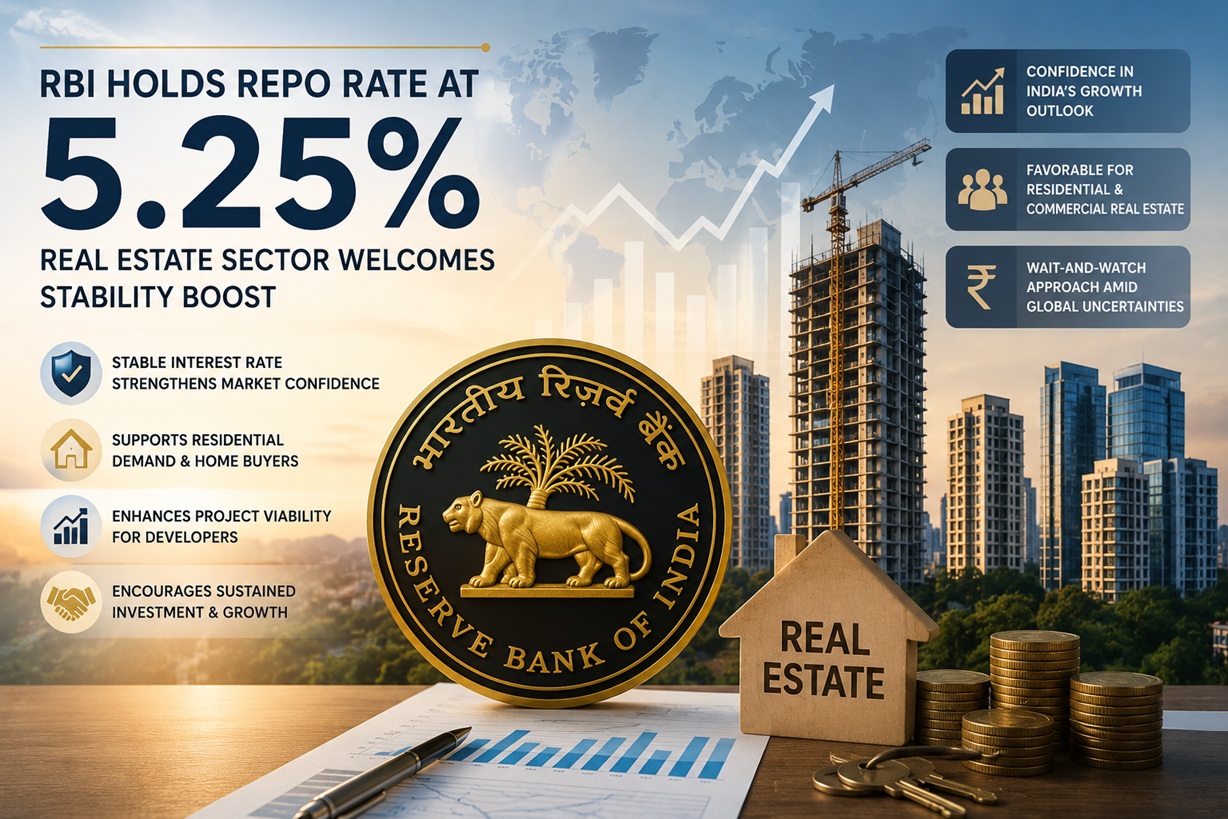
The Reserve Bank of India's recent decision to maintain the repo rate at 5.25% has been met with approval from the real estate sector, reflecting a strategic 'wait-and-watch' approach amid ongoing global economic uncertainties, geopolitical tensions, and inflationary pressures. The RBI's stance indicates confidence in India's economic growth trajectory, bolstered by revisions in near-term GDP projections. Such a stable interest rate environment is viewed as beneficial for sustaining both residential and commercial real estate demand. Developers express optimism that consistent borrowing costs will enhance project viability and visibility for various market segments, even as expectations for a potential future rate cut continue.
Industry leaders, such as Deepak Kapoor from Gulshan Group, emphasize that the RBI's decision reinforces confidence in India's economic resilience against a backdrop of global volatility. He notes that the stability in borrowing costs fosters a conducive environment for sustained demand across residential segments. Similarly, Prateek Tiwari of Prateek Group highlights how maintaining the repo rate at 5.25% strengthens market sentiment, reassuring homebuyers and maintaining stable financing conditions, which are particularly crucial for first-time buyers and end-users in high-demand areas.
Sahil Agarwal, CEO of Nimbus Group, supports this view, stating that the RBI's neutral policy reflects a forward-looking approach to managing economic uncertainties. The continuity in borrowing costs is anticipated to support end-user demand and strengthen project viability. This environment is expected to encourage sustained investments across the sector, reinforcing a positive outlook. However, Amit Modi of County Group suggests that while the stability is beneficial, a marginal rate cut could have provided substantial relief for first-time homebuyers grappling with affordability challenges in urban markets. He emphasizes that the current phase is more about resilience than rapid acceleration, where maintaining confidence is as important as the cost of capital.
Furthermore, Sanchit Bhutani of Group 108 points out that a steady repo rate, coupled with a neutral policy stance, is advantageous for the commercial real estate sector. This stability enhances visibility on borrowing costs, which is crucial for developers, investors, and occupiers. It allows developers to engage in more predictable project planning and effective liquidity management. Overall, the RBI's decision to hold the repo rate steady is expected to foster a stable environment for real estate, encouraging continued growth and investment in the sector, even as stakeholders remain vigilant about future economic shifts.