When Saudi Arabia first unveiled NEOM’s The Line in 2021, the announcement instantly captured global attention. Conceived as part of the kingdom’s Vision 2030 transformation agenda, the project signaled an extraordinary ambition: to build a 170-kilometre-long linear city in the desert that would operate entirely on renewable energy and redefine how people live, move, and interact with urban space. The concept emerged from Crown Prince Mohammed bin Salman’s goal of creating a new economic engine—one that moves Saudi Arabia beyond oil and positions it as a hub for futuristic living and sustainable technology.
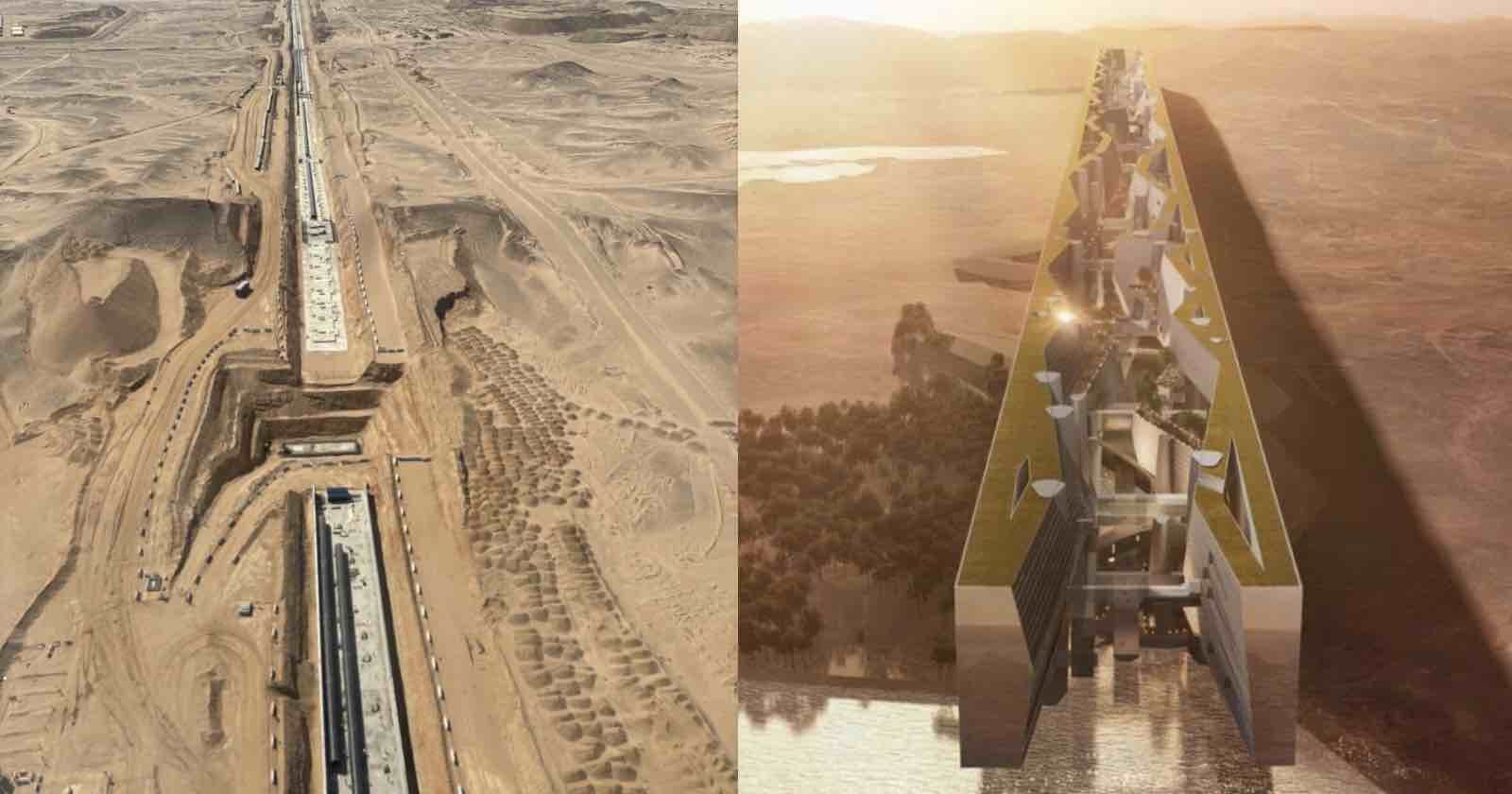
The Line’s planning strategy broke sharply from conventional urban development. Instead of expanding outward, NEOM proposed a vertical city built in a narrow corridor, enclosing residential, commercial, and community zones within two parallel mirrored walls. The structure was designed with three distinct layers: a pedestrian-only level at the top, a dedicated services level in the middle, and an ultra-high-speed transit system below. This configuration aimed to eliminate cars and long commutes, ensure walkability for all residents, and protect 95% of NEOM’s surrounding natural environment. Designers also envisioned AI-integrated services, automated logistics, and climate-controlled interiors—creating a highly efficient ecosystem where daily needs are accessible within minutes.
Construction began in phases between 2022 and 2023, starting with groundwork, tunneling, and foundation preparation. Satellite footage and aerial photography through 2024 and 2025 confirmed visible progress, showing excavation zones stretching several kilometers across the chosen corridor. However, despite early momentum, several international reports suggested that the scale of the project was being recalibrated. By 2025, NEOM was reportedly prioritizing the development of an initial segment—ranging from roughly 2.4 to 4 kilometers—while adopting a more phased, financially sustainable rollout for the remainder of the city. The shift reflected the engineering complexity of building such a structure, as well as the significant resources required to realize its full length.
The Line’s unprecedented design offers notable advantages: a carbon-neutral urban environment, zero dependence on private vehicles, and a layout that maximizes space while minimizing land disruption. Its vertical format promises quicker access to services, improved energy efficiency, and seamless integration of advanced technology. Yet the model also raises practical questions. Building and maintaining a megastructure of this scale requires new engineering methods, immense capital, and long-term operational infrastructure. Some urban planners have expressed concerns about ventilation, sunlight distribution, and the adaptability of a fully enclosed city. Others have pointed to the project’s long construction timeline and potential challenges of maintaining such a concentrated population in a single linear zone.
Initial announcements projected major portions of The Line to be ready by 2030. Current assessments, however, suggest that only the first built segment may meet that target, with the larger vision unfolding gradually over subsequent decades. NEOM representatives continue to stress that the development is intended as a multi-generational project—one that will evolve as technology and urban planning practices advance.
On the commercial front, NEOM has opened selective discussions with investors and early buyers for various districts within the broader NEOM portfolio—such as Trojena, Oxagon, and Sindalah. For The Line specifically, widespread public sales have not yet begun, though inquiries are ongoing. Pricing details remain limited, but media reports indicate that premium residential offerings across NEOM’s luxury zones may command prices ranging from the high six figures to several million dollars, depending on location and design.
From its bold unveiling in 2021 to its current early construction phase, The Line remains one of the world’s most intriguing urban experiments. Even with revised timelines and phased execution, it continues to symbolize Saudi Arabia’s determination to push the boundaries of architecture, sustainability, and futuristic living.