
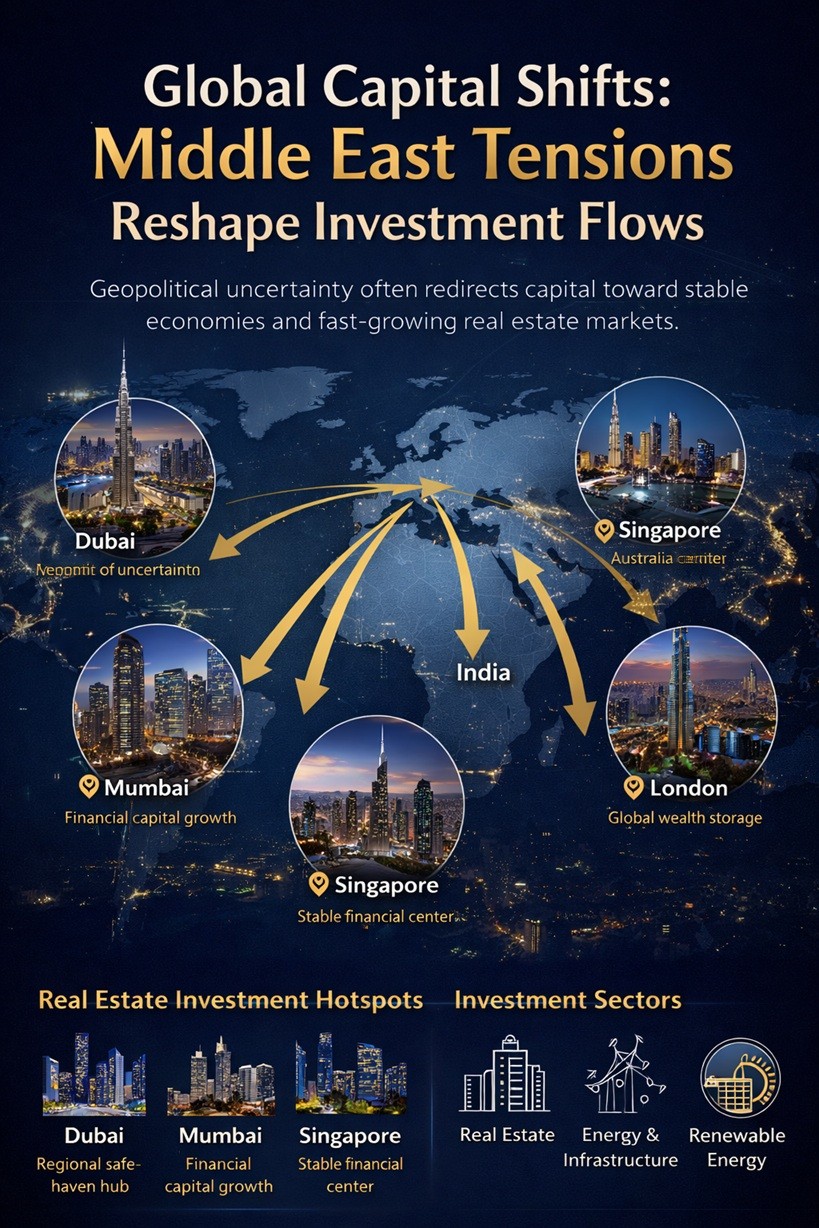
Geopolitical tensions in the Middle East have historically influenced global investment patterns, often prompting investors to reassess risk exposure and diversify their portfolios geographically. While conflicts in the region can create short-term uncertainty in energy markets and trade routes, they also tend to redirect capital toward markets perceived as politically stable and economically resilient. For global investors, such shifts often represent not only a response to risk but also an opportunity to explore emerging investment destinations.
In periods of geopolitical instability, capital typically flows toward jurisdictions offering stability, transparency, and long-term economic growth. Major global financial hubs such as New York, London, and Singapore frequently benefit from this shift, as investors seek reliable regulatory frameworks and deep capital markets. At the same time, several emerging economies are increasingly attracting attention due to their growth potential, improving infrastructure, and expanding urbanization. Countries like India, Vietnam, and Indonesia have steadily strengthened their position as attractive destinations for global capital.
Real estate, in particular, often becomes a preferred asset class during periods of geopolitical uncertainty. Property markets in cities with strong economic fundamentals and growing demand for housing and commercial space tend to experience heightened investor interest. For instance, India’s rapidly expanding urban centers, including Mumbai, Bengaluru, and Hyderabad, are drawing attention from both domestic and international investors due to their strong technology sectors, rising middle class, and large-scale infrastructure development.
Interestingly, certain locations within the Middle East itself can also benefit from regional uncertainty. Cities such as Dubai have long positioned themselves as financial and logistics hubs with global connectivity, robust infrastructure, and investor-friendly policies. These attributes allow them to attract capital even during periods of broader regional tension, reinforcing their role as gateways between East and West.
Beyond real estate, global investors are also exploring opportunities in infrastructure, renewable energy, and technology sectors in regions experiencing sustained economic growth. Governments in several emerging markets have accelerated policy reforms aimed at improving ease of doing business and encouraging foreign investment, further strengthening their appeal.
Ultimately, geopolitical tensions rarely halt global investment flows altogether. Instead, they tend to reshape capital allocation patterns, pushing investors toward markets that offer a combination of stability, transparency, and growth potential. In this evolving landscape, both established financial centers and rapidly developing economies are likely to play an increasingly important role in absorbing redirected global capital.