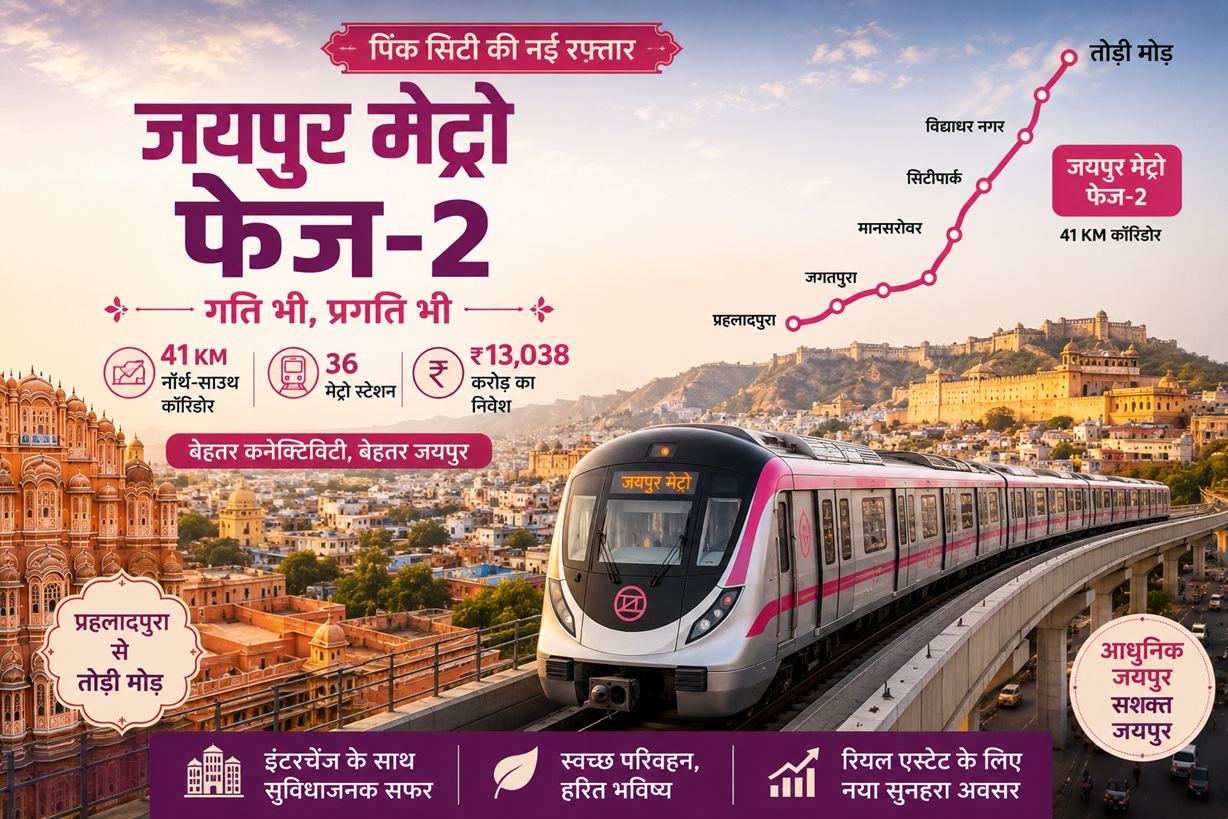
Jaipur, known as the Pink City, is undergoing rapid urbanization, resulting in a pressing need for improved transportation solutions to alleviate the traffic congestion that has become increasingly prevalent. In response to this challenge, the Government of India has greenlit the Jaipur Metro Phase 2 project, a significant step towards modernizing the city's infrastructure. This new phase aims to establish a North-South corridor stretching approximately 41 kilometers, connecting Prahladpura in the south to Todi Mod in the north. With a total of 36 metro stations, primarily elevated and a few strategically placed underground, this project is poised to enhance connectivity in high-density areas, including those surrounding the airport.
The Jaipur Metro Phase 2 initiative is projected to require an investment of around ₹13,038 crore, making it one of the largest infrastructure undertakings in Rajasthan. Managed by the Rajasthan Metro Rail Corporation Limited (RMRCL), a collaboration between the central and state governments, the project is expected to complete construction before September 2031, with several phases planned to ensure efficient execution. A key aspect of this expansion is the integration with the existing Phase 1 corridor through interchange stations, which will facilitate seamless travel across the metro network. This enhanced connectivity is anticipated to significantly improve access to various industrial, commercial, and residential hubs, fostering economic growth and operational efficiency across the city.
In addition to bolstering transportation, Jaipur Metro Phase 2 aligns with India's broader goals of promoting sustainability in urban environments. By providing an efficient public transit option, the metro aims to reduce carbon emissions associated with road traffic. The implications of this project on the real estate market in Jaipur are expected to be profound. Historical data from cities like Delhi, Bengaluru, and Mumbai demonstrates that metro connectivity typically drives property demand and increases prices in the vicinity of metro stations. In Jaipur, it is anticipated that properties adjacent to metro stations will see a consistent rise in value due to the added convenience and accessibility.
Moreover, neighborhoods such as Sitapura, Jagatpura, and Vidhyadhar Nagar are poised to emerge as attractive investment hotspots in light of the metro expansion. The demand for rental properties is also likely to surge, as professionals and students seek residences near metro stations for easy access to workplaces and educational institutions. Overall, the Jaipur Metro Phase 2 project epitomizes the principles of Transit-Oriented Development (TOD), promoting a cohesive urban framework where public transport accessibility drives residential and commercial growth, ultimately transforming the Pink City into a more connected and economically vibrant metropolis.