

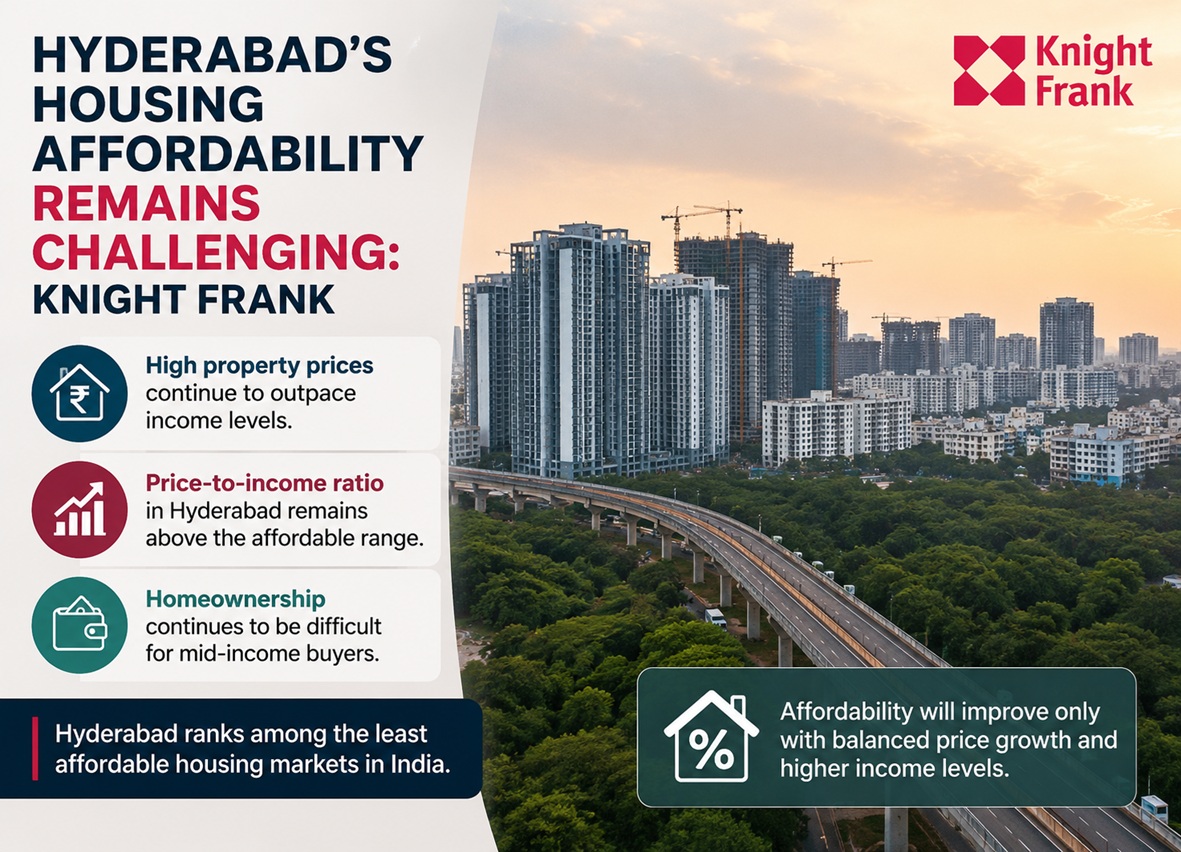
According to Knight Frank India's latest Affordability Index, Hyderabad has retained its position as the third least affordable residential market among India's eight major cities during the first half of 2026. Households in the city are required to allocate 41% of their monthly income towards servicing home loan equated monthly instalments (EMIs). This figure remains unchanged from the end of 2025, despite the Reserve Bank of India (RBI) implementing a cumulative 125 basis points of monetary easing over the same period. The index serves as a critical gauge, assessing the proportion of household income necessary to cover monthly EMIs for housing units.
The Affordability Index indicates that an EMI-to-income ratio exceeding 50% is deemed unaffordable, as financial institutions typically do not extend mortgages beyond this threshold. In comparison, the Mumbai Metropolitan Region and the National Capital Region recorded even higher ratios at 69% and 67%, respectively. Other major cities showed varying degrees of affordability, with Bengaluru at 35%, Chennai at 29%, Pune at 28%, Kolkata at 25%, and Ahmedabad at 23%. Interestingly, Ahmedabad has emerged as the most affordable residential market among the eight cities reviewed in the report.
The report highlights that six out of the eight cities remain within the generally accepted affordability threshold of 50%. While affordability has slightly worsened in Bengaluru and the National Capital Region compared to 2025, Hyderabad and other markets have maintained relative stability. The recent rate cuts by the RBI have contributed to lower borrowing costs, which are anticipated to support housing demand in the latter half of 2026. However, rising residential property prices are tempering any significant improvements in overall affordability.
Historically, housing affordability in India's major cities showed a steady improvement from 2016 to 2021, with the pandemic era providing an additional boost as the RBI slashed policy rates to unprecedented lows. Nevertheless, the situation reversed after the central bank raised the repo rate by 250 basis points between May 2022 and early 2023 to combat inflation. Although recent monetary easing has facilitated some recovery in home loan affordability, the upward trajectory of residential property prices continues to pose challenges for potential homeowners in Hyderabad and beyond.

