
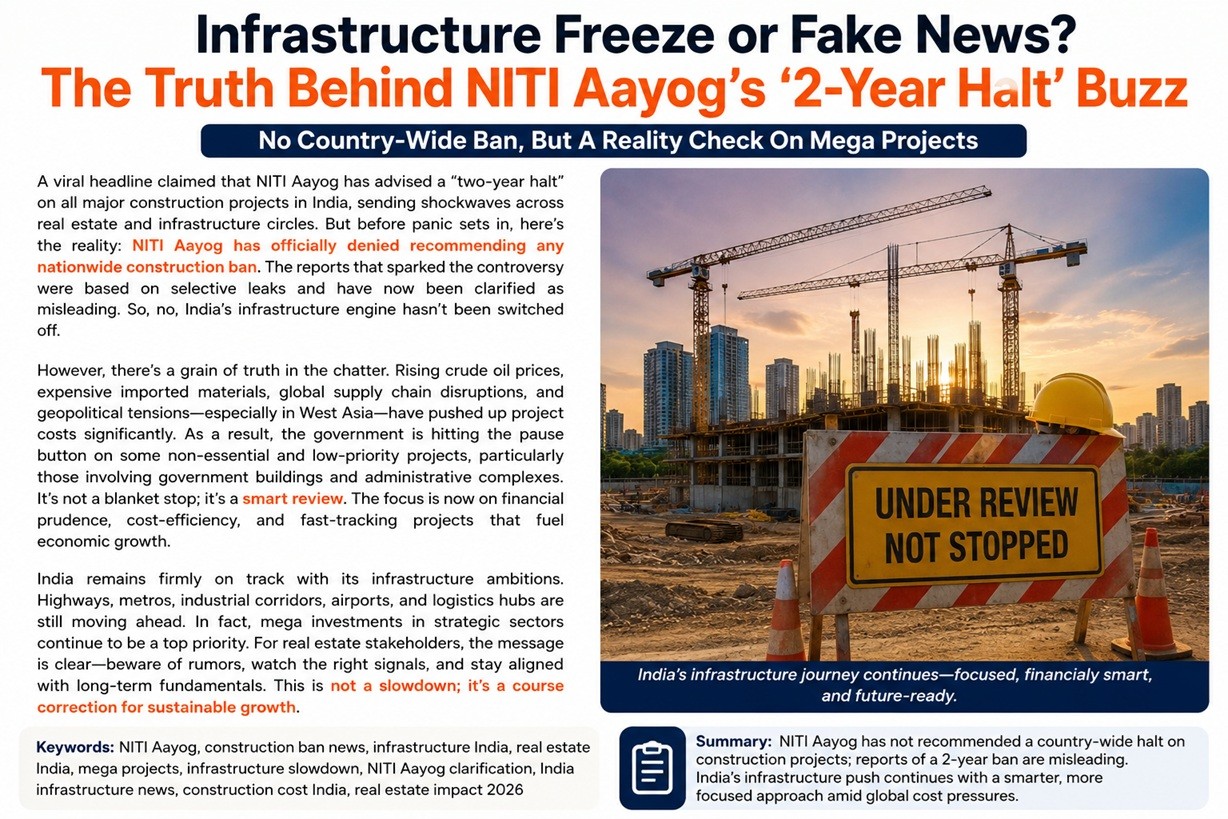
India’s infrastructure story has long been one of speed, ambition and giant skylines rising from dust-covered construction zones. From expressways and airports to luxury towers and smart cities, the country has spent the last decade positioning itself as one of the world’s fastest-growing construction economies. That is why recent reports claiming that NITI Aayog advised a two-year halt on major construction projects instantly triggered concern across the real estate, infrastructure and investment sectors. The headlines spread rapidly across social media and television, creating fears that India’s infrastructure momentum was suddenly hitting the brakes. But beneath the noise, the reality appears more complex than the viral narrative. While some reports suggested that escalating geopolitical tensions, rising crude oil prices and imported material costs were forcing authorities to rethink large-scale projects, NITI Aayog later clarified that it had not officially recommended any nationwide construction ban. The clarification calmed markets to some extent, but the episode exposed a deeper concern already developing within India’s construction ecosystem.
The truth is that India’s infrastructure sector is currently navigating a period of financial caution rather than complete paralysis. Construction costs have surged due to global supply chain disruptions, expensive logistics, volatile fuel prices and rising steel and cement expenses. Large government projects now require tighter financial scrutiny, phased execution and stronger return calculations. Several highway and urban development projects have reportedly experienced delays because of land acquisition challenges, approval bottlenecks and funding pressure. However, India’s broader infrastructure vision remains firmly alive. Massive investments continue in metros, industrial corridors, logistics parks, data centres, airports and urban redevelopment projects across major cities. For the real estate sector, this situation may actually reshape the market rather than weaken it. Developers are likely to become more selective, focusing on high-demand micro markets, premium housing corridors and infrastructure-linked growth zones instead of aggressive expansion everywhere. Investors too are expected to prioritise stable long-term projects with strong connectivity and economic backing. In many ways, the current phase may mark the beginning of a more strategic and disciplined era for Indian construction rather than an outright slowdown. The viral headlines may have created panic, but India’s infrastructure engine is far from shutting down — it is simply entering a phase where precision may matter more than speed.